
Resihance (Regorafenib) 40 Mg
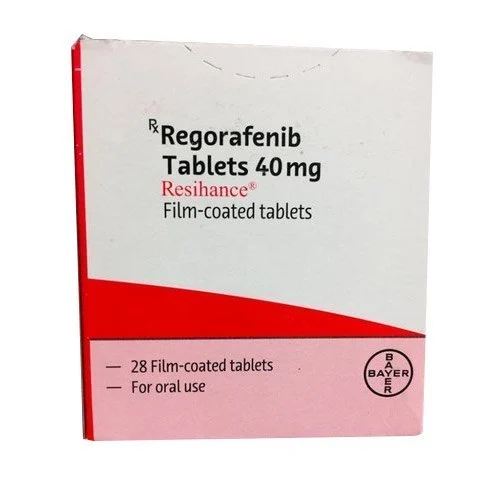
Price range: $700.00 through $1,932.00
| Active Ingredient | Regorafenib |
|---|---|
| Manufacturer | Bayer Zydus Pharma |
| Packaging | 28 tablets in 1 strip |
| Strength | 40mg |
| Delivery Time | 6 To 15 days |
| SKU: | Resihance (Regorafenib) – 40 Mg |
Resihance (Regorafenib) 40 Mg: Uses, Dosage, Side Effects & Complete Guide
When cancer progresses despite standard treatments, the search for the next option can feel overwhelming. That’s the reality many patients and families face — and it’s exactly the situation where Resihance (Regorafenib) – 40 Mg steps in as a meaningful medical option.
Regorafenib is not a new name in oncology. It has been studied, approved, and used globally for several years in treating advanced cancers that have stopped responding to conventional therapies. If your oncologist has recommended Resihance, this guide will help you understand what it is, how it works, what to expect, and how to take it safely — all explained in clear, human language.
What Is Resihance (Regorafenib) 40 Mg?
Resihance is a brand name for Regorafenib, an oral targeted therapy tablet available in a 40 mg strength. It belongs to a class of anticancer drugs known as multikinase inhibitors — a type of targeted therapy that works differently from traditional chemotherapy.
Unlike conventional chemotherapy that broadly attacks all rapidly dividing cells, Regorafenib works with precision — targeting specific proteins and enzymes involved in tumor growth, progression, and the formation of new blood vessels that feed tumors.
The standard prescribed dose is 160 mg per day (four 40 mg tablets taken together), used in carefully defined treatment cycles. Resihance is an oral medication, meaning it is taken by mouth — no infusions or injections required.
It is used in advanced or metastatic cancers that have progressed after standard treatments, making it a critical option for patients with limited remaining alternatives.
Understanding Regorafenib: The Science Made Simple
Regorafenib is a small molecule multikinase inhibitor. In plain language, it is a drug that blocks multiple kinase enzymes simultaneously — enzymes that cancer cells rely on to grow, divide, and spread.
Here are the key targets Regorafenib blocks:
- VEGFR1, VEGFR2, VEGFR3 — Vascular Endothelial Growth Factor Receptors that control the formation of new blood vessels (angiogenesis). Tumors need new blood vessels to grow. By blocking these receptors, Regorafenib starves the tumor of its blood supply
- PDGFR-β — Platelet-Derived Growth Factor Receptor beta, involved in blood vessel stabilization around tumors
- FGFR — Fibroblast Growth Factor Receptor, involved in tumor cell proliferation
- KIT and RET — oncoproteins that drive certain cancer cell types
- RAF kinases (CRAF, BRAF) — involved in the RAS/MAPK signaling pathway that drives cancer cell growth and survival
- TIE2 — involved in tumor vasculature
- DAPK1 — involved in cancer cell survival
By simultaneously targeting all these pathways, Regorafenib delivers a multi-front attack on cancer — blocking its blood supply, inhibiting its growth signals, and disrupting its survival mechanisms all at once.
What Is Resihance (Regorafenib) 40 Mg Used For?
1. Metastatic Colorectal Cancer (mCRC)
This is the most prominent approved use of Resihance (Regorafenib) – 40 Mg. It is indicated for patients with metastatic colorectal cancer who have previously been treated with — and progressed on — standard therapies including:
- Fluoropyrimidine-based chemotherapy
- Oxaliplatin and irinotecan
- Anti-VEGF therapy (e.g., Bevacizumab)
- Anti-EGFR therapy (if RAS wild-type — e.g., Cetuximab or Panitumumab)
In the landmark CORRECT trial, Regorafenib demonstrated a statistically significant improvement in overall survival compared to placebo in previously treated mCRC patients — a meaningful result in a population with very limited options.
2. Gastrointestinal Stromal Tumors (GIST)
Resihance is also approved for patients with locally advanced, unresectable, or metastatic GIST who have been previously treated with Imatinib and Sunitinib — the two standard first- and second-line treatments for GIST.
The GRID trial confirmed Regorafenib’s effectiveness in this setting, showing significant improvement in progression-free survival compared to placebo in patients whose GIST had progressed on prior therapies.
3. Hepatocellular Carcinoma (HCC — Primary Liver Cancer)
Resihance (Regorafenib) – 40 Mg is approved as a second-line treatment for patients with hepatocellular carcinoma who have previously been treated with Sorafenib (the standard first-line therapy for advanced HCC) and whose disease has progressed.
The RESORCE trial was a pivotal study that demonstrated Regorafenib significantly improved overall survival in Sorafenib-pretreated HCC patients — making it the first drug to show survival benefit in second-line HCC treatment.
4. Other Investigational Uses
Regorafenib is being studied in clinical trials for other cancers including:
- Non-small cell lung cancer (NSCLC)
- Soft tissue sarcomas
- Thyroid cancer
- Ovarian cancer
- Osteosarcoma
Resihance (Regorafenib) 40 Mg Dosage Guide
Correct dosing is critical for both effectiveness and safety. Here is everything you need to know about how to take Resihance properly.
Standard Recommended Dose:
160 mg orally once daily (four 40 mg tablets taken together at the same time)
Treatment Cycle:
- Take for 21 days ON, then 7 days OFF — this 28-day cycle is repeated continuously
- The 7-day rest period is important — it allows the body to recover from side effects, particularly hand-foot skin reaction and fatigue
How to Take Resihance 40 Mg Tablets:
- Take with a low-fat breakfast (fat content less than 30% of calories) — food is required for adequate absorption
- Swallow tablets whole — do not crush, chew, or split
- Take at the same time every day during the 21 treatment days
- Take with a full glass of water
- If you vomit after taking your dose, do not take an additional dose that day
What If You Miss a Dose?
- If you miss a dose, take it on the same day as soon as you remember
- If the next day has already arrived, skip the missed dose and resume your normal schedule
- Never take two doses on the same day to make up for a missed one
Dose Modifications:
Your oncologist may reduce your dose based on tolerability:
| Dose Level | Daily Dose | Number of 40 mg Tablets |
|---|---|---|
| Starting dose | 160 mg | 4 tablets |
| First reduction | 120 mg | 3 tablets |
| Second reduction | 80 mg | 2 tablets |
| Discontinuation | If 80 mg not tolerated | Stop treatment |
Common reasons for dose reduction include:
- Severe hand-foot skin reaction (HFSR)
- High blood pressure that cannot be controlled
- Significant liver enzyme elevation
- Severe fatigue or other grade 3–4 toxicities
📌 Never adjust your dose on your own. All dose modifications must be directed by your oncologist.
How Does Resihance Work Against Cancer?
Let’s put it in everyday terms. Imagine a tumor is a city — it needs roads (blood vessels) to bring in supplies (oxygen and nutrients) and communication networks (signaling pathways) to coordinate its activities.
Resihance (Regorafenib) works like a multi-target disruption force:
- It cuts off the roads — by blocking VEGFR, it prevents the tumor from building new blood vessels, cutting off its supply lines
- It jams the communication networks — by blocking RAF, KIT, RET, and PDGFR, it disrupts the signals that tell cancer cells to grow and divide
- It weakens the city’s defenses — by targeting DAPK1 and TIE2, it makes the tumor environment less hospitable for cancer cell survival
The result is a tumor that cannot grow, cannot spread, and slowly begins to lose its support structure — leading to stabilization of disease, reduction in tumor size in some cases, or slowing of progression.
Common Side Effects of Resihance (Regorafenib) 40 Mg
It’s important to go into treatment with a clear picture of potential side effects. Most side effects of Resihance are manageable with the right support and monitoring, but some require prompt medical attention.
Very Common Side Effects:
1. Hand-Foot Skin Reaction (HFSR) / Palmar-Plantar Erythrodysesthesia (PPE) This is the most characteristic and frequently reported side effect of Regorafenib. It involves:
- Redness, swelling, pain, blistering, or peeling of the palms of hands and soles of feet
- Can range from mild tingling and redness to severe, painful blistering that limits daily activities
Management tips:
- Moisturize hands and feet daily with thick cream or ointment
- Wear well-cushioned, comfortable shoes
- Avoid prolonged pressure on hands and feet
- Report worsening to your oncologist promptly
2. Fatigue Deep, persistent tiredness is very common and can significantly affect quality of life. Pacing activities, gentle exercise, and good nutrition can help manage fatigue.
3. Hypertension (High Blood Pressure) Regorafenib commonly raises blood pressure due to its anti-angiogenic effects. Regular blood pressure monitoring — at home and in clinic — is essential. Most patients require antihypertensive medication during treatment.
4. Diarrhea Loose or frequent stools are common. Staying well hydrated, following dietary adjustments, and using prescribed antidiarrheal medications (like Loperamide) as directed helps manage this.
5. Mucositis / Mouth Sores Painful mouth ulcers can develop. Good oral hygiene, soft foods, and alcohol-free mouthwashes help reduce discomfort.
6. Loss of Appetite and Weight Loss Reduced appetite is common. Working with a dietitian to maintain caloric intake is important during treatment.
7. Voice Changes (Dysphonia) A hoarse or changed voice is frequently reported with Regorafenib — it is generally mild and not dangerous.
Other Common Side Effects:
- Nausea and vomiting
- Constipation
- Skin rash (beyond HFSR)
- Headache
- Fever
- Muscle stiffness or pain
- Dry skin or hair thinning
- Elevated liver enzymes (transaminases)
Serious Side Effects (Seek Immediate Medical Attention):
- Severe hepatotoxicity (liver damage) — jaundice, dark urine, severe abdominal pain, extreme fatigue; liver failure has been reported (rare but serious)
- Hemorrhage (severe bleeding) — gastrointestinal bleeding, respiratory tract bleeding; Regorafenib inhibits blood vessel repair mechanisms
- Gastrointestinal perforation or fistula — sudden severe abdominal pain, fever, nausea — a rare but potentially life-threatening complication
- Cardiac ischemia or infarction — chest pain, shortness of breath, arm or jaw pain; rare but reported
- Reversible posterior leukoencephalopathy syndrome (RPLS) — a rare neurological complication presenting as severe headache, seizures, confusion, or vision problems
- Severe skin reactions — including Stevens-Johnson Syndrome (rare)
- Wound healing complications — Regorafenib impairs wound healing; it must be stopped before any surgery
⚠️ Any chest pain, severe abdominal pain, neurological symptoms, or jaundice during treatment requires immediate emergency medical attention.
Who Should NOT Take Resihance (Regorafenib) 40 Mg?
Resihance is not appropriate for everyone. Consult your oncologist immediately if any of the following apply:
- Known hypersensitivity to Regorafenib or any tablet excipient
- Severe hepatic impairment (Child-Pugh C) — Regorafenib is contraindicated; it has not been studied in this population and carries high risk of severe liver toxicity
- Pregnancy — Regorafenib is highly teratogenic and must not be used during pregnancy; reliable contraception is mandatory during treatment and for at least 2 months after the last dose for women and 2 months after for men
- Breastfeeding — do not breastfeed during treatment and for 2 weeks after the last dose
- Patients with uncontrolled hypertension — blood pressure must be controlled before starting
- Patients with planned major surgery — Regorafenib should be stopped at least 2 weeks before elective surgery due to wound healing impairment
- Patients with recent serious bleeding events — risk of further hemorrhage
Important Drug Interactions With Resihance
Regorafenib is metabolized by CYP3A4 and is a substrate of UGT1A9. Several drugs significantly affect its blood levels:
| Drug / Category | Effect | Recommendation |
|---|---|---|
| Strong CYP3A4 inducers (Rifampicin, Carbamazepine, Phenytoin, St. John’s Wort) | Drastically reduce Regorafenib levels | AVOID — risk of treatment failure |
| Strong CYP3A4 inhibitors (Ketoconazole, Clarithromycin, Ritonavir) | Increase Regorafenib levels | AVOID — increased toxicity risk |
| Warfarin | Regorafenib may increase INR | Monitor INR closely; consider LMWH |
| UGT1A1/UGT1A9 substrates (e.g., Irinotecan) | Regorafenib inhibits these enzymes, increasing drug levels | Use with caution |
| Neomycin | May decrease Regorafenib absorption | Caution advised |
| Live vaccines | Risk of serious infection | Avoid during treatment |
📌 Always provide your complete medication list — including over-the-counter drugs, herbal supplements, and vitamins — to your oncologist and pharmacist before starting Resihance.
Important Precautions During Treatment
1. Liver Function Monitoring Liver function tests (ALT, AST, bilirubin) must be checked before starting, at weeks 2 and 4 of the first two cycles, and monthly thereafter. Liver toxicity is one of the most serious risks of Regorafenib.
2. Blood Pressure Monitoring Check blood pressure weekly for the first 6 weeks, then monthly. Patients with pre-existing hypertension need careful management before and during treatment.
3. Electrolyte Monitoring Regorafenib can affect electrolyte levels. Regular monitoring and supplementation may be necessary.
4. Skin Care Protocol Start a proactive hand and foot care routine before treatment begins — not after HFSR develops. Preventive moisturizing, comfortable footwear, and avoiding friction go a long way.
5. Pregnancy Prevention Both male and female patients must use effective contraception during treatment. The teratogenic risk of Regorafenib is serious and well-documented.
6. No Grapefruit Grapefruit and grapefruit juice inhibit CYP3A4 and can increase Regorafenib blood levels, raising toxicity risk. Avoid grapefruit during treatment.
Frequently Asked Questions About Resihance (Regorafenib) 40 Mg
Q: How long will I take Resihance?
Treatment continues as long as your cancer responds or remains stable and the side effects are manageable. Your oncologist will monitor your response through imaging and blood tests every 6–8 weeks and decide on continuation.
Q: Why do I take it for 21 days and then stop for 7 days?
The 21-days-on, 7-days-off cycle is specifically designed to balance effectiveness with tolerability. The 7-day break allows your body — especially your skin, liver, and blood pressure — to recover before the next cycle begins.
Q: Can I take Resihance with my regular medications?
Possibly, but this must be carefully reviewed. Regorafenib has significant drug interactions. Your oncologist and pharmacist must review your entire medication list before you start treatment.
Q: Is hand-foot skin reaction avoidable?
It cannot always be prevented, but it can be significantly reduced with proactive skin care — regular moisturizing, comfortable footwear, avoiding prolonged pressure on hands and feet, and reporting early signs to your doctor promptly.
Q: What makes Resihance different from chemotherapy?
Unlike traditional chemotherapy that broadly kills all fast-dividing cells, Resihance is a targeted therapy — it specifically blocks molecular pathways that drive tumor growth and blood supply. This means a different — and in many ways more precise — mechanism of action and a distinct side effect profile.
Final Thoughts
Resihance (Regorafenib) – 40 Mg represents a genuine advance in targeted oncology — offering patients with advanced colorectal cancer, GIST, and hepatocellular carcinoma a meaningful treatment option when other therapies have stopped working. Its multi-kinase inhibition approach, proven in landmark clinical trials, has extended lives and provided hope in situations where options were diminishing.
That said, it is a powerful medication that requires respect — strict adherence to the dosing schedule, proactive monitoring of side effects, careful dietary and drug interaction management, and a strong partnership with your oncology team.
If you have been prescribed Resihance, take each cycle one step at a time. Stay in close contact with your healthcare team, report side effects early, take care of your skin, monitor your blood pressure, and never skip your follow-up appointments. Every tablet you take is part of a purposeful, science-backed fight against your cancer.
You are not alone in this — and Resihance is a powerful ally in your corner.
Disclaimer:-
This article is for informational and educational purposes only and does not constitute medical advice, diagnosis, or treatment recommendation. Always consult a qualified oncologist or healthcare professional before starting, stopping, or modifying any cancer treatment, including Resihance (Regorafenib) – 40 Mg.
Additional information
| unit | 28 Tablets, 56 Tablet, 84 Tablet |
|---|


Reviews
There are no reviews yet.