
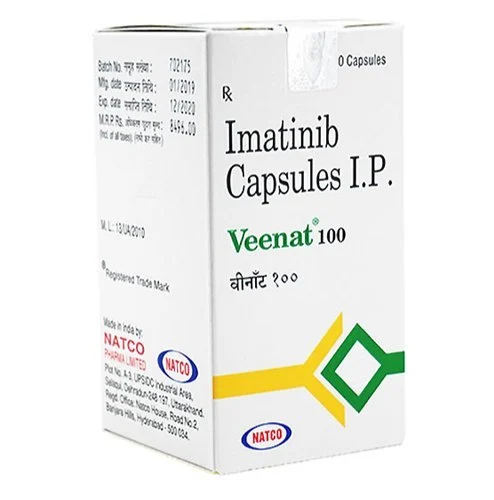
Veenat 100 Mg (Imatinib)
Price range: $85.00 through $240.00
| Active Ingredient | Imatinib |
|---|---|
| Manufacturer | Natco Pharma Ltd. |
| Packaging | 10 Tablets in Strip & 120 Tablets in Bottle |
| Strength | 100mg |
| Delivery Time | 6 To 15 days |
| SKU: | Veenat 100 Mg (Imatinib) |
Veenat 100 Mg (Imatinib): Uses, Dosage, Side Effects & Complete Guide
There are very few moments in the history of modern medicine as transformative as the arrival of Imatinib. Before it existed, a diagnosis of chronic myeloid leukemia (CML) carried a grim prognosis — with most patients facing eventual disease transformation and limited survival options. Then came Imatinib — and everything changed.
Today, patients with CML who take Imatinib consistently can expect a near-normal life expectancy — a statement that would have seemed impossible just three decades ago. That is not an exaggeration. It is the documented, clinical reality of what this medication has achieved — and why it remains one of the most celebrated breakthroughs in oncology history.
If Veenat 100 Mg (Imatinib) has been prescribed to you or someone you care about, this comprehensive guide will walk you through everything you need to know — clearly, completely, and in genuinely human language.
What Is Veenat 100 Mg (Imatinib)?
Veenat 100 Mg is an oral targeted therapy tablet containing Imatinib Mesylate equivalent to 100 mg of Imatinib as the active ingredient. It is manufactured by Cipla Ltd. — one of India’s most globally recognized pharmaceutical companies — and is one of the most widely prescribed and trusted generic versions of the originator brand Gleevec (Glivec) worldwide.
Imatinib belongs to the class of targeted anticancer drugs called tyrosine kinase inhibitors (TKIs) — the first drug of its kind to demonstrate the extraordinary power of targeting a specific molecular abnormality in cancer. It was the pioneering molecule that launched the era of molecular targeted cancer therapy — transforming oncology from a field of broad cytotoxic treatments to one of precision molecular medicine.
Veenat is available in two strengths — 100 mg and 400 mg — allowing oncologists to precisely tailor the dose to each patient’s condition, disease phase, and treatment response. The 100 mg tablet is particularly important for achieving exact daily doses in specific indications and for making incremental dose adjustments when needed.
Imatinib is listed on the World Health Organization’s List of Essential Medicines — one of the most significant recognitions of a drug’s global clinical importance — and remains a first-line standard of care for multiple malignancies more than two decades after its initial approval.
The Revolutionary Story Behind Imatinib
Understanding Imatinib’s significance requires a brief look at the science that created it — because it is genuinely one of medicine’s most remarkable stories.
In patients with CML, a chromosomal abnormality called the Philadelphia chromosome (Ph) is present in virtually all leukemic cells. This abnormality results from a translocation between chromosomes 9 and 22 — producing a fusion gene called BCR-ABL. The BCR-ABL gene encodes an abnormal tyrosine kinase protein that is permanently and constitutively active — constantly telling leukemia cells to grow, divide, and resist normal cell death signals.
Scientists identified BCR-ABL as the molecular driver of CML. The challenge was: could a drug be designed to specifically block this one protein without disrupting the hundreds of other normal cellular processes?
Imatinib was that drug. Developed through a collaboration between Brian Druker at Oregon Health & Science University and Novartis scientists in the late 1990s, Imatinib was the world’s first rationally designed, molecularly targeted cancer therapy. Its clinical trial results were so dramatic — achieving complete hematologic responses in virtually all chronic-phase CML patients — that it received FDA approval in record time in 2001.
The story of Imatinib is the story of how understanding cancer at the molecular level can transform treatment outcomes — and it remains the foundational proof of concept for the entire field of targeted oncology.
How Does Veenat 100 Mg (Imatinib) Work?
Here is the mechanism explained in clear, accessible terms:
Blocking the Molecular Engine of Leukemia
In CML, the BCR-ABL fusion protein is an abnormal tyrosine kinase — an enzyme that transfers phosphate groups to target proteins, activating downstream signaling cascades that drive:
- Uncontrolled cell proliferation
- Resistance to apoptosis (programmed cell death)
- Impaired differentiation of blood cell precursors
- Genomic instability — accumulation of further mutations
Imatinib works by fitting precisely into the ATP-binding pocket of the BCR-ABL kinase — the site where ATP (the cell’s energy currency) must bind for the kinase to function. By occupying this pocket, Imatinib:
- Blocks ATP from binding — the kinase cannot transfer phosphate groups
- Downstream signaling stops — the growth and survival signals the leukemia cells depend on are silenced
- Leukemia cells undergo apoptosis — they stop receiving survival signals and self-destruct
- Normal blood cell production recovers — as the leukemic clone is suppressed
Beyond BCR-ABL — Multiple Kinase Targets
Imatinib is not exclusively a BCR-ABL inhibitor. It also potently inhibits several other tyrosine kinases:
- c-KIT (CD117) — the molecular driver of gastrointestinal stromal tumors (GISTs)
- PDGFR-α and PDGFR-β (Platelet-Derived Growth Factor Receptors) — drivers of several rare cancers including dermatofibrosarcoma protuberans and hypereosinophilic syndrome
- ABL — the normal Abelson kinase
- ARG (ABL-related gene)
This multi-kinase inhibitory profile explains Imatinib’s effectiveness across a surprisingly broad range of malignancies beyond CML — all of which share dysregulated activity of one or more of these kinase targets.
What Is Veenat 100 Mg (Imatinib) Used For?
1. Chronic Myeloid Leukemia (CML) — Primary Indication
Veenat 100 Mg is the cornerstone treatment for Philadelphia chromosome-positive (Ph+) CML across all disease phases:
Chronic Phase CML: This is the most common presentation at diagnosis — and where Imatinib delivers its most extraordinary results. The landmark IRIS trial (International Randomized Study of Interferon and STI571) demonstrated:
- Complete hematologic response (CHR) in virtually 100% of patients
- Complete cytogenetic response (CCyR) — elimination of Ph+ cells detectable by conventional cytogenetics — in 82% of patients at 18 months
- 10-year overall survival of 83.3% — transforming CML from a disease with median survival of 3–5 years to one with near-normal life expectancy
- Imatinib remains the standard first-line therapy for chronic-phase CML, with second-generation TKIs (Dasatinib, Nilotinib) reserved for high-risk patients or Imatinib intolerance/resistance
Accelerated Phase CML: For patients who have progressed from chronic to accelerated phase, higher doses of Imatinib (600 mg/day) are used — with meaningful response rates
Blast Phase (Blast Crisis) CML: Imatinib at 600–800 mg/day can achieve responses in blast crisis — though responses are typically shorter-lived and combination approaches or allogeneic stem cell transplant may be necessary
2. Gastrointestinal Stromal Tumors (GISTs)
This is the second major, clinically landmark indication for Imatinib. GISTs are the most common mesenchymal tumors of the gastrointestinal tract — and approximately 85% carry activating mutations in the c-KIT gene, which Imatinib potently inhibits.
Before Imatinib, metastatic GIST had a median survival of less than 12 months with no effective systemic therapy. Imatinib transformed this:
- The B2222 trial demonstrated an overall response rate of 53.7% and disease control rate of approximately 84% in metastatic/unresectable GIST
- Median overall survival extended to approximately 5 years in responding patients
- Imatinib is approved for:
- Unresectable or metastatic GIST
- Adjuvant treatment after surgical resection of KIT-positive GIST (to reduce recurrence risk)
- The ACOSOG Z9001 and SSG XVIII trials established 3 years of adjuvant Imatinib as significantly superior to 1 year in high-risk GIST
3. Philadelphia Chromosome-Positive Acute Lymphoblastic Leukemia (Ph+ ALL)
In Ph+ ALL — a high-risk subtype of ALL that carries the BCR-ABL fusion — Imatinib in combination with chemotherapy has significantly improved outcomes. It is used both in:
- Induction therapy — in combination with steroids and chemotherapy
- Maintenance/consolidation — post-remission therapy
- As a bridge to allogeneic stem cell transplantation
4. Myelodysplastic/Myeloproliferative Diseases with PDGFR Rearrangements
Imatinib is approved for rare myeloid disorders with PDGFR-α or PDGFR-β gene rearrangements — including chronic eosinophilic leukemia and certain myeloproliferative neoplasms. Response rates are exceptional — often achieving complete molecular remission.
5. Aggressive Systemic Mastocytosis
Imatinib is used for aggressive systemic mastocytosis without the D816V c-KIT mutation — where c-KIT inhibition can achieve meaningful disease control.
6. Hypereosinophilic Syndrome (HES) with FIP1L1-PDGFRA Fusion
Imatinib produces complete remission in the majority of patients with HES carrying the FIP1L1-PDGFRA fusion — a truly transformative outcome in a previously difficult-to-treat condition.
7. Dermatofibrosarcoma Protuberans (DFSP)
Imatinib is approved for unresectable, recurrent, or metastatic DFSP — a rare skin sarcoma driven by COL1A1-PDGFB fusion — which activates PDGFR-β signaling that Imatinib effectively blocks.
Veenat 100 Mg Dosage Guide
Imatinib dosing varies significantly by indication and disease phase. The 100 mg tablet is critical for achieving the precise doses required across these varied indications.
Standard Doses by Indication:
| Indication | Standard Dose | Notes |
|---|---|---|
| CML — Chronic Phase | 400 mg once daily | 4 × Veenat 100 Mg tablets |
| CML — Accelerated Phase | 600 mg once daily | 6 × Veenat 100 Mg tablets |
| CML — Blast Crisis | 600–800 mg daily | 6–8 × Veenat 100 Mg tablets |
| Ph+ ALL | 600 mg once daily | In combination with chemotherapy |
| GIST — Metastatic/Unresectable | 400 mg once daily | May increase to 800 mg if progression |
| GIST — Adjuvant | 400 mg once daily | 3 years post-resection |
| PDGFR+ MDS/MPN | 400 mg once daily | Often achieves complete remission |
| HES with FIP1L1-PDGFRA | 100–400 mg once daily | Start at 100 mg; increase if needed |
| Aggressive Systemic Mastocytosis | 400 mg once daily | Without D816V mutation |
| DFSP | 800 mg daily (400 mg twice daily) |
How to Take Veenat 100 Mg Correctly:
- Take with a meal and a large glass of water — this significantly reduces gastrointestinal side effects; taking on an empty stomach increases nausea considerably
- Take at the same time every day — consistency maintains stable plasma drug levels essential for sustained molecular response
- Swallow tablets whole — do not crush or chew; if swallowing is difficult, tablets may be dispersed in a glass of water or apple juice (stir until dissolved and drink immediately)
- The daily dose may be taken as a single dose or split into two doses (morning and evening) — particularly for doses of 800 mg to reduce GI side effects
- Never skip doses — even feeling completely well does not mean leukemia or GIST is controlled without medication
- If you miss a dose, take it as soon as you remember on the same day; if the next day has arrived, skip it — never double up
- Store at room temperature (below 30°C), away from moisture and direct sunlight
Dose Modifications:
| Toxicity | Action |
|---|---|
| Grade 3–4 neutropenia (ANC < 1.0 × 10⁹/L) | Withhold; restart at same or reduced dose when ANC ≥ 1.5 × 10⁹/L |
| Grade 3–4 thrombocytopenia (platelets < 50 × 10⁹/L) | Withhold; restart at same or reduced dose when platelets ≥ 75 × 10⁹/L |
| Grade 3 non-hematologic toxicity | Withhold until resolved; reduce dose by 100–200 mg |
| Grade 4 non-hematologic toxicity | Withhold; restart at significantly reduced dose or consider discontinuation |
| Severe hepatotoxicity | Withhold; reassess; reduce dose or discontinue |
Common Side Effects of Veenat 100 Mg (Imatinib)
Imatinib is generally well-tolerated compared to traditional chemotherapy — but it is not without side effects. Understanding them helps you prepare and respond effectively.
Very Common Side Effects:
1. Nausea and Vomiting The most commonly reported side effect — particularly early in treatment. Taking Veenat with a meal and a large glass of water dramatically reduces this. For most patients, nausea improves significantly after the first 2–4 weeks as the body adjusts.
Management:
- Always take with food
- Antiemetics (Ondansetron, Metoclopramide) if needed
- Avoid large, heavy meals around dosing time
- Ginger-containing products may help mild nausea
2. Fluid Retention and Edema One of Imatinib’s most characteristic and distinguishing side effects:
- Periorbital edema — swelling around the eyes, particularly in the morning; very common and often the first noticed
- Lower limb edema — swelling of ankles and feet
- Pleural effusion — fluid around the lungs (less common; more serious)
- Pericardial effusion — fluid around the heart (rare)
- Ascites — fluid in the abdomen (rare)
Management:
- Reduce salt intake
- Elevation of legs when resting
- Diuretics (prescribed by oncologist) for significant edema
- Dose reduction if fluid retention is severe
3. Muscle Cramps Very commonly reported — particularly in calf muscles and hands. Often worse at night.
Management:
- Tonic water (quinine)
- Calcium/magnesium supplementation
- Adequate hydration
- Gentle stretching
4. Myelosuppression (Bone Marrow Suppression)
- Neutropenia — low white blood cell count; infection risk
- Thrombocytopenia — low platelets; bleeding risk
- Anemia — low red blood cells; fatigue, breathlessness
- Most pronounced in the first 2–3 months; managed with dose adjustments and growth factors if needed
5. Diarrhea
- Loose stools or increased stool frequency; usually mild and manageable with dietary modifications and Loperamide if needed
6. Fatigue
- General tiredness; very commonly reported; often improves after the initial adjustment period
7. Skin Rash
- Mild to moderate rash; typically manageable with topical treatments or antihistamines
8. Elevated Liver Enzymes (Hepatotoxicity)
- Transaminase elevation detected on blood tests; usually asymptomatic
- Severe hepatotoxicity is rare but requires dose modification or temporary discontinuation
9. Bone and Joint Pain
- Musculoskeletal pain, particularly in legs and joints; often mild
Serious Side Effects (Seek Immediate Medical Attention):
- Severe fluid retention — sudden weight gain (> 2 kg in 24 hours), significant shortness of breath, severe leg swelling; may indicate pleural or pericardial effusion
- Severe hepatotoxicity — jaundice, dark urine, severe fatigue, right upper abdominal pain
- Febrile neutropenia — fever ≥ 38°C with low white blood cell count; medical emergency; go to emergency department immediately
- Gastrointestinal bleeding — particularly in GIST patients where tumor necrosis can cause GI hemorrhage
- Cardiac toxicity — heart failure has been reported (rare); monitor cardiac function particularly in patients with pre-existing cardiac disease
- Severe skin reactions — Stevens-Johnson Syndrome (extremely rare)
- Tumor lysis syndrome — rapid breakdown of cancer cells causing electrolyte abnormalities; primarily a concern in blast crisis CML and Ph+ ALL
- Severe hypersensitivity — rare but requires immediate discontinuation
⚠️ Any sudden weight gain, severe breathing difficulty, chest pain, high fever, or signs of bleeding require immediate emergency medical attention during Veenat treatment. Do not wait.
Who Should NOT Take Veenat 100 Mg?
- Patients with known hypersensitivity to Imatinib or any tablet excipient
- Patients with severe hepatic impairment — use with significant caution; dose reduction required; liver function must be closely monitored
- Patients with severe cardiac disease or heart failure — Imatinib can worsen cardiac function; specialist cardiology assessment required
- Pregnant women — Imatinib is teratogenic; it can cause fetal harm; highly effective contraception is mandatory during treatment; do not use during pregnancy unless the benefit clearly outweighs risk
- Breastfeeding women — Imatinib is excreted in breast milk; breastfeeding must be stopped before starting treatment
- Patients with severe renal impairment — use with caution; dose adjustment may be needed based on creatinine clearance
Important Drug Interactions With Veenat 100 Mg
Imatinib is primarily metabolized by CYP3A4 and also inhibits CYP3A4, CYP2D6, and CYP2C9 — creating a clinically important drug interaction profile:
| Drug / Category | Interaction | Recommendation |
|---|---|---|
| Strong CYP3A4 inducers (Rifampicin, Phenytoin, Carbamazepine, St. John’s Wort) | Significantly reduce Imatinib levels — risk of treatment failure | AVOID — consider alternative medications |
| Strong CYP3A4 inhibitors (Ketoconazole, Clarithromycin, Ritonavir) | Increase Imatinib exposure — increased toxicity | Use with caution; monitor for toxicity |
| Warfarin | Imatinib inhibits CYP2C9 — increases Warfarin effect | AVOID — use LMWH instead; if Warfarin must be used, monitor INR very closely |
| Simvastatin / Lovastatin | Imatinib increases statin levels — myopathy risk | Use lower statin doses; consider Pravastatin or Rosuvastatin |
| Cyclosporine | Imatinib significantly increases Cyclosporine levels | Monitor levels closely; dose adjustment likely needed |
| Paracetamol (Acetaminophen) | Potential hepatotoxicity risk when combined | Avoid high doses; use lowest effective dose |
| Grapefruit/grapefruit juice | CYP3A4 inhibition — increases Imatinib levels | Avoid during treatment |
| Metoprolol / other beta-blockers metabolized by CYP2D6 | Imatinib increases their plasma levels | Monitor heart rate and blood pressure |
| Levothyroxine | Imatinib may reduce Levothyroxine absorption or increase clearance | Monitor thyroid function; adjust dose as needed |
| Ibuprofen / NSAIDs | Additive risk of GI bleeding and fluid retention | Use with caution; prefer Paracetamol for pain |
📌 The Warfarin interaction is particularly dangerous — Imatinib can significantly increase Warfarin’s anticoagulant effect, causing serious or fatal bleeding. Always use LMWH (low molecular weight heparin) for anticoagulation in patients taking Imatinib.
Treatment Monitoring — What to Expect
Monitoring during Imatinib therapy for CML is one of the most structured and evidence-based monitoring programs in all of oncology — guided by international response milestones.
Hematologic Response Monitoring (CML):
- CBC with differential — every 2 weeks for the first 3 months, then monthly until stable
- Goal: Complete hematologic response (CHR) — normalization of blood counts — by 3 months
Cytogenetic Response Monitoring:
- Bone marrow cytogenetics or FISH — at 3 and 6 months
- Goal: Complete cytogenetic response (CCyR) — no Ph+ cells detectable — by 12 months
Molecular Response Monitoring (Most Important Long-Term):
- BCR-ABL quantitative PCR (RT-qPCR) from peripheral blood — every 3 months
- Goal: Major molecular response (MMR / MR3.0) — BCR-ABL/ABL ratio ≤ 0.1% on International Scale — by 12–18 months
- Deep molecular response (MR4.0, MR4.5) — achieved with long-term therapy; prerequisite for Treatment-Free Remission (TFR) attempts
GIST Monitoring:
- CT scan — every 3–6 months to assess tumor response
Liver Function and Blood Counts:
- Regular liver function tests — baseline and every 4–6 weeks for the first year, then periodically
Treatment-Free Remission (TFR) — A Goal Unique to CML
One of the most remarkable and hopeful developments in CML management is the concept of Treatment-Free Remission (TFR) — the possibility, for select patients, of stopping Imatinib while maintaining a deep molecular response.
The STIM, TWISTER, and EURO-SKI trials have demonstrated that approximately 40–60% of patients who achieve a sustained deep molecular response (MR4.5 maintained for ≥ 2 years) can successfully discontinue Imatinib without disease recurrence — remaining in molecular remission without any medication.
Prerequisites for TFR attempt:
- Chronic-phase CML only
- On Imatinib for ≥ 5 years
- Achieved and sustained MR4.5 for ≥ 2 years
- Access to monthly PCR monitoring for the first year after stopping
- Agreement to restart immediately if molecular relapse occurs
📌 TFR is not appropriate for all patients and must only be attempted under the close supervision of an experienced hematologist with access to frequent molecular monitoring. Never stop Veenat without medical guidance — unmonitored discontinuation can lead to rapid disease relapse.
Frequently Asked Questions About Veenat 100 Mg (Imatinib)
Q: Is Veenat 100 Mg a chemotherapy drug?
Not in the traditional sense. Imatinib is a targeted tyrosine kinase inhibitor — it works by precisely blocking a specific molecular driver of cancer (BCR-ABL, c-KIT, PDGFR) rather than broadly killing all rapidly dividing cells like traditional chemotherapy. This precision is why it is better tolerated than conventional chemotherapy and why it can be taken daily as a long-term oral medication.
Q: Do I need to take Veenat for the rest of my life?
For most CML patients, Imatinib is a long-term, indefinitely continued therapy. However, for patients who achieve and sustain a deep molecular response (MR4.5) for a sufficient duration, Treatment-Free Remission (TFR) — stopping Imatinib while remaining in remission — is now a realistic goal for select patients under specialist supervision. Discuss TFR eligibility with your hematologist.
Q: What if Veenat stops working?
If Imatinib loses effectiveness — usually due to the development of BCR-ABL resistance mutations — second-generation TKIs such as Dasatinib (Sprycel), Nilotinib (Tasigna), or Bosutinib (Bosulif) are highly effective next-line options. The specific resistance mutation identified through mutation analysis guides the choice of next-line TKI. The T315I gatekeeper mutation requires third-generation TKI Ponatinib (Iclusig) or other specialized approaches.
Q: Can I take Veenat with food?
Yes — and it is strongly recommended to do so. Taking Veenat 100 Mg with a meal and a large glass of water significantly reduces nausea and gastrointestinal discomfort — the most common early side effects of Imatinib. Never take it on an empty stomach if avoidable.
Q: Why is Cipla’s Veenat considered so important globally?
Cipla’s production of Veenat made Imatinib therapy accessible at a fraction of the originator brand price — particularly in India, sub-Saharan Africa, and other resource-limited settings where the cost of Glivec/Gleevec was prohibitive. This affordability has meant that thousands of patients who would otherwise have been unable to access this life-transforming treatment can now receive it. It is a landmark example of how generic pharmaceutical production can save lives at scale.
Disclaimer:-
This article is for informational and educational purposes only and does not constitute medical advice, diagnosis, or treatment recommendation. Always consult a qualified hematologist, oncologist, or healthcare professional before starting, stopping, or modifying any cancer treatment, including Veenat 100 Mg (Imatinib).
Additional information
| unit | 360 Tablets, 120 Tablets, 240 Tablet |
|---|



Reviews
There are no reviews yet.