
Pomalid 2 Mg (Pomalidomide)
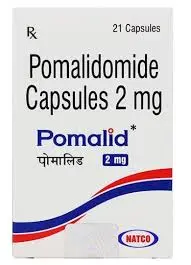
Price range: $248.00 through $985.00
| Active Ingredient | Pomalidomide |
|---|---|
| Manufacturer | Natco Pharma Ltd. |
| Packaging | 21 capsules in 1 strip |
| Strength | 2mg |
| Delivery Time | 6 To 15 days |
| SKU: | Pomalid 2 Mg (Pomalidomide) |
Pomalid 2 Mg (Pomalidomide): Uses, Dosage, Side Effects & Complete Guide
A multiple myeloma diagnosis is one of the most challenging things a person can face. The treatments are complex, the journey is long, and finding the right medication — especially after other therapies have stopped working — can feel like searching for a lifeline. That’s precisely where Pomalid 2 Mg (Pomalidomide) comes into the picture.
Pomalidomide is not just another cancer drug. It represents a significant step forward in the treatment of relapsed and refractory multiple myeloma — a blood cancer that affects plasma cells in the bone marrow. If your oncologist has recommended Pomalid 2 Mg, this comprehensive guide will help you understand exactly what it is, how it works, what to expect during treatment, and how to take it as safely as possible.
What Is Pomalid 2 Mg (Pomalidomide)?
Pomalid 2 Mg is an oral anticancer capsule containing Pomalidomide 2 mg as its active ingredient. It is manufactured by Natco Pharma Ltd. — a well-established Indian pharmaceutical company known for producing high-quality oncology generics — and is widely prescribed as a cost-effective alternative to the originator brand Pomalyst.
Pomalidomide belongs to a class of drugs called immunomodulatory imide drugs (IMiDs) — a unique and powerful category of anticancer agents that work through multiple mechanisms simultaneously, including direct anticancer activity, immune system modulation, and anti-angiogenic effects.
Pomalid is the third-generation IMiD, following Thalidomide (first generation) and Lenalidomide (second generation). Each generation has been progressively more potent and better tolerated, with Pomalidomide demonstrating remarkable activity even in patients whose cancer has become resistant to both Lenalidomide and Bortezomib — two of the most important drugs in multiple myeloma treatment.
Pomalid 2 Mg is part of a combination regimen — most commonly used with Dexamethasone, and increasingly in triple combinations with agents like Daratumumab or Bortezomib.
Understanding Multiple Myeloma: The Target
Before diving deeper into how Pomalid works, it helps to understand the disease it treats.
Multiple myeloma is a cancer of plasma cells — the white blood cells in bone marrow responsible for producing antibodies. In multiple myeloma, abnormal plasma cells multiply uncontrollably, crowding out healthy blood cells, weakening bones, impairing kidney function, and suppressing the immune system.
Multiple myeloma is generally not curable, but it is highly treatable — with modern therapies achieving remissions that can last for years. When the disease relapses (comes back) or becomes refractory (stops responding to treatment), finding the next effective therapy becomes critical. That’s where Pomalid 2 Mg plays its most important role.
How Does Pomalid 2 Mg (Pomalidomide) Work?
Pomalidomide’s mechanism of action is multi-dimensional — it attacks myeloma through several pathways simultaneously, which is a key reason for its effectiveness even in heavily pretreated, resistant disease.
1. Direct Anti-Myeloma Activity
Pomalidomide binds to a protein called cereblon (CRBN) — part of a cellular protein degradation complex. By binding to cereblon, Pomalidomide triggers the targeted destruction of two transcription factors — Ikaros (IKZF1) and Aiolos (IKZF3) — that myeloma cells depend on for survival and proliferation. Without these proteins, myeloma cells undergo apoptosis (programmed cell death) — they essentially self-destruct.
2. Immune System Activation (Immunomodulation)
Pomalidomide powerfully activates T-cells and Natural Killer (NK) cells — the immune system’s frontline cancer-fighting forces. By enhancing these immune responses, it enables the body’s own defense system to recognize and destroy myeloma cells more effectively. This is the “immunomodulatory” part of its name.
3. Anti-Angiogenic Effects
Like all IMiDs, Pomalidomide inhibits the formation of new blood vessels (angiogenesis) within the bone marrow tumor environment. Myeloma cells, like all tumors, need a blood supply to grow. By blocking this, Pomalidomide helps starve the cancer of the nutrients it needs to expand.
4. Inhibition of the Tumor Microenvironment
Pomalidomide disrupts the communication between myeloma cells and the bone marrow stromal cells that support them — breaking down the protective niche that allows myeloma cells to hide from treatment.
This combination of direct cell killing, immune activation, anti-angiogenesis, and microenvironment disruption makes Pomalidomide one of the most comprehensively active agents in myeloma treatment.
What Is Pomalid 2 Mg (Pomalidomide) Used For?
1. Relapsed and Refractory Multiple Myeloma (RRMM) — Primary Indication
Pomalid 2 Mg is specifically approved for the treatment of relapsed and refractory multiple myeloma in adult patients who have received at least two prior therapies — including both Lenalidomide and a proteasome inhibitor (e.g., Bortezomib or Carfilzomib) — and whose disease has progressed on or within 60 days of completing the last therapy.
This is critically important: Pomalid fills a major gap in myeloma treatment by offering effective options for patients whose cancer is no longer responding to the standard backbone drugs.
2. Combination Regimens
Pomalid 2 Mg is approved and used in several combination regimens:
- Pd (Pomalidomide + Dexamethasone) — the foundational combination; proven in the MM-003 trial
- DPd (Daratumumab + Pomalidomide + Dexamethasone) — approved for RRMM after ≥1 prior line; APOLLO trial demonstrated superior PFS
- VPd (Bortezomib + Pomalidomide + Dexamethasone) — used in certain relapsed settings
- KPd (Carfilzomib + Pomalidomide + Dexamethasone) — increasingly used in heavily pretreated patients
- IsaPd (Isatuximab + Pomalidomide + Dexamethasone) — ICARIA-MM trial showed significant benefit
3. Kaposi’s Sarcoma (Investigational/Approved in Some Regions)
Pomalidomide has received approval in some markets for AIDS-related Kaposi’s sarcoma after failure of highly active antiretroviral therapy (HAART), based on its antitumor and immunomodulatory activity.
Pomalid 2 Mg Dosage Guide
Chemotherapy dosing requires absolute precision. Here is how Pomalid 2 Mg is typically dosed:
Standard Adult Dose:
4 mg orally once daily on Days 1–21 of each 28-day cycle
This typically means taking 2 capsules of Pomalid 2 Mg (total 4 mg) once daily for 21 days, followed by 7 days off.
In Combination With Dexamethasone:
Dexamethasone is typically given at 40 mg once weekly (or 20 mg for patients over 75 years) on Days 1, 8, 15, and 22 of each 28-day cycle.
Treatment Cycles:
Pomalid is continued until disease progression or unacceptable toxicity. Unlike short-course treatments, myeloma therapy is often ongoing for months to years.
Dose Modifications:
| Toxicity | Action |
|---|---|
| Grade 3–4 neutropenia (ANC < 500/mm³) | Interrupt treatment; restart at 3 mg after recovery |
| Febrile neutropenia | Interrupt; restart at 3 mg after recovery |
| Grade 3–4 thrombocytopenia (platelets < 25,000/mm³) | Interrupt; restart at 3 mg after recovery |
| Subsequent recurrence of above | Further dose reduction to 2 mg |
| Grade 3–4 non-hematologic toxicity | Hold until resolved; reduce by 1 mg |
| Minimum dose | 1 mg/day |
How to Take Pomalid 2 Mg:
- Take once daily at approximately the same time each day
- Can be taken with or without food
- Swallow capsules whole with water — do not open, crush, or chew
- If you miss a dose and it is less than 12 hours since your usual time, take it; if more than 12 hours have passed, skip the missed dose
- Never double up on doses
- Store at room temperature (below 30°C), away from moisture and heat
- Wear gloves when handling — Pomalid is a cytotoxic agent; caregivers must not open or handle capsules directly
The REVLIMID Risk Management Program & Pregnancy Prevention
This is the most critical safety section for anyone taking or handling Pomalid 2 Mg (Pomalidomide).
Pomalidomide is a thalidomide analogue — and Thalidomide is historically notorious for causing severe, life-threatening birth defects (phocomelia — limb deformities) when taken during pregnancy in the 1960s. Pomalidomide carries the same teratogenic risk.
Because of this, Pomalidomide is subject to a strict Risk Evaluation and Mitigation Strategy (REMS) program in many countries — in the US, this is called the POMALYST REMS program. In India and other markets, equivalent pregnancy prevention programs apply.
Key Requirements:
For Female Patients of Childbearing Potential:
- Must have two negative pregnancy tests before starting — one 10–14 days before and one 24 hours before the first dose
- Must use two forms of effective contraception simultaneously — starting 4 weeks before treatment, throughout treatment, and for 4 weeks after the last dose
- Must have monthly pregnancy tests during treatment
- Must never share Pomalidomide with anyone else
For Male Patients:
- Must use a condom during sexual activity with women of childbearing potential — even if they have had a vasectomy — during treatment and for 4 weeks after the last dose
- Must not donate sperm during treatment and for 4 weeks after
For All Patients:
- Must not donate blood during treatment and for 1 month after the last dose
- Must return or dispose of unused capsules as directed
🚨 This is not optional. These pregnancy prevention requirements exist to prevent catastrophic fetal harm. Compliance is mandatory and non-negotiable.
Common Side Effects of Pomalid 2 Mg (Pomalidomide)
Understanding side effects helps you prepare and respond appropriately. Here’s a comprehensive overview:
Very Common Side Effects:
1. Myelosuppression (Bone Marrow Suppression) This is the most frequently observed and clinically significant side effect:
- Neutropenia (low white blood cells) — the most common; increases infection risk significantly
- Anemia (low red blood cells) — causes fatigue, shortness of breath, pallor
- Thrombocytopenia (low platelets) — increases bleeding and bruising risk
Regular blood count monitoring is essential throughout treatment.
2. Fatigue Deep, persistent tiredness is very commonly reported. Pacing activities, gentle exercise, and maintaining good nutrition can help manage this.
3. Upper Respiratory Infections Due to immune suppression, patients are more susceptible to infections — especially respiratory ones. Pneumonia is a serious concern.
4. Peripheral Neuropathy Numbness, tingling, or burning sensations in the hands and feet — though generally less severe with Pomalidomide than with Thalidomide.
5. Constipation and Diarrhea Both can occur — constipation is more common with IMiD therapy. Adequate hydration and dietary fiber help.
6. Nausea Generally mild and manageable with antiemetics if needed.
7. Back Pain and Musculoskeletal Pain Common in myeloma patients due to bone involvement and treatment effects.
8. Dyspnea (Shortness of Breath) Can be related to anemia, lung infections, or rarely pulmonary embolism.
Serious Side Effects (Report to Oncologist Immediately):
- Venous Thromboembolism (VTE) — deep vein thrombosis (DVT) and pulmonary embolism (PE) are significantly increased with Pomalidomide, especially in combination with Dexamethasone. Blood clot prevention (thromboprophylaxis) with aspirin, low molecular weight heparin (LMWH), or warfarin is routinely prescribed alongside Pomalid
- Febrile Neutropenia — fever with critically low white blood cell count; a medical emergency requiring immediate hospitalization
- Severe Infections — including pneumonia, sepsis, and opportunistic infections
- Hepatotoxicity — liver enzyme elevation; monitor liver function regularly
- Second Primary Malignancies — small increased risk of secondary cancers with long-term IMiD use
- Tumor Lysis Syndrome (TLS) — rare but possible rapid breakdown of cancer cells causing electrolyte abnormalities
- Severe Skin Reactions — Stevens-Johnson Syndrome (rare but serious)
- Hypersensitivity Reactions — including angioedema; discontinue immediately
⚠️ Any fever, chest pain, leg swelling, or difficulty breathing during treatment requires immediate emergency medical attention.
Who Should NOT Take Pomalid 2 Mg?
- Patients with known hypersensitivity to Pomalidomide or any capsule component
- Pregnant women — absolute contraindication; teratogenic risk is severe
- Women who may become pregnant without strict adherence to the pregnancy prevention program
- Patients with severe hepatic impairment — use with caution; dose adjustment may be needed
- Patients with severe renal impairment on dialysis — pharmacokinetic data is limited; specialist guidance needed
- Patients unable or unwilling to comply with thromboprophylaxis requirements
- Patients with active serious infection — treat infection before starting Pomalidomide
- Breastfeeding women — discontinue breastfeeding before starting treatment
Important Drug Interactions With Pomalid 2 Mg
| Drug / Category | Interaction | Recommendation |
|---|---|---|
| CYP1A2 inhibitors (e.g., Fluvoxamine, Ciprofloxacin) | Increase Pomalidomide exposure | Use with caution; monitor |
| CYP3A4 inhibitors (e.g., Ketoconazole) | May increase levels | Monitor for increased toxicity |
| CYP3A4 inducers (e.g., Rifampicin, St. John’s Wort) | Reduce Pomalidomide levels | Avoid — risk of reduced efficacy |
| Dexamethasone | Used intentionally — combination partner | Doctor-directed; monitor closely |
| Anticoagulants / Antiplatelets | Combined with thromboprophylaxis agents | Required; monitor bleeding and clotting |
| Live vaccines | Risk of serious infection | Avoid during and after treatment |
| Erythropoiesis-stimulating agents (ESAs) | Increased VTE risk when combined | Use with caution; assess risk |
| Digoxin | Pomalidomide may increase Digoxin levels | Monitor Digoxin levels |
Important Monitoring During Pomalid Treatment
Your oncology team will schedule regular tests and assessments throughout treatment:
Blood Count Monitoring (CBC):
- Weekly for the first 8 weeks of treatment
- Monthly thereafter
- Before each new treatment cycle
Bone Marrow Response Assessment:
- Serum protein electrophoresis (SPEP)
- Free light chain assay
- Bone marrow biopsy when indicated
- Imaging as required
Liver and Kidney Function:
- Baseline and periodic monitoring throughout treatment
Thrombosis Surveillance:
- Monitor for symptoms of DVT (leg pain, swelling, redness) and PE (chest pain, breathlessness)
Pregnancy Testing (for applicable patients):
- Monthly throughout treatment
Frequently Asked Questions About Pomalid 2 Mg (Pomalidomide)
Q: How is Pomalid 2 Mg different from Lenalidomide?
Both are IMiDs, but Pomalidomide is more potent and specifically designed to work in patients who have become resistant to Lenalidomide. Pomalidomide has stronger cereblon binding and greater immunomodulatory activity — making it effective where Lenalidomide has stopped working.
Q: How long will I need to take Pomalid 2 Mg?
Pomalid is continued until disease progression or unacceptable toxicity. This can mean months or years of treatment. Your oncologist will assess your response regularly through blood tests and imaging to determine how long to continue.
Q: Is Pomalid 2 Mg a chemotherapy drug?
Pomalidomide is technically classified as an immunomodulatory agent and targeted therapy rather than traditional chemotherapy. It works through immune activation and targeted molecular mechanisms rather than broadly killing all fast-dividing cells — though it is used as part of cancer treatment.
Q: Can I work and live normally while taking Pomalid 2 Mg?
Many patients continue working and maintaining daily activities during treatment, particularly when side effects are well managed. Fatigue and infection risk are the primary limitations. Discuss your activity level and any occupational concerns with your oncologist.
Q: What happens if my myeloma progresses on Pomalid?
If the disease progresses on a Pomalidomide-containing regimen, your oncologist will discuss next-line options — which may include newer agents such as Selinexor, Belantamab mafodotin, CAR-T cell therapy, or clinical trial options. Myeloma treatment has multiple lines available today.
Disclaimer:-
This article is for informational and educational purposes only and does not constitute medical advice, diagnosis, or treatment recommendation. Always consult a qualified oncologist or hematologist before starting, stopping, or modifying any cancer treatment, including Pomalid 2 Mg (Pomalidomide).
Additional information
| mg | 2 Mg, 4 Mg |
|---|---|
| unit | 21 Capsules, 42 Capsules, 63 Capsules |






Reviews
There are no reviews yet.